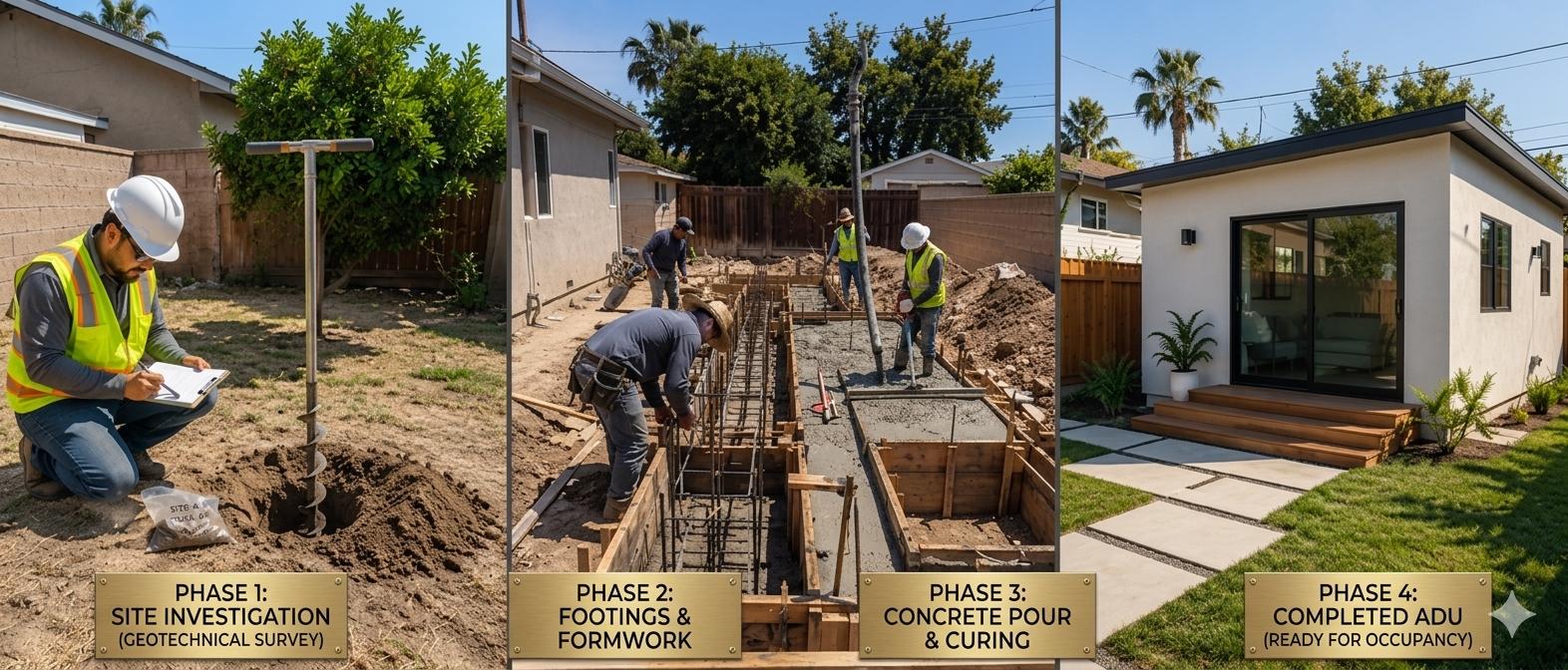
If you're planning to build an ADU in Los Angeles or the surrounding SoCal area, you've probably got a long to-do list — permits, architects, contractors. A geotechnical report might not be at the top of your list, but for many properties it should be one of the first things you get.
Here's a straightforward breakdown of what a geo report covers, when you actually need one, and what we found on a real ADU project in Thousand Oaks.
Not every ADU project requires a full geotechnical investigation — but many do, especially in Southern California where hillside lots, expansive soils, and complex grading histories are common.
You'll likely need a geotechnical report if your property has any of these:
Even on relatively flat lots, a geo report gives your structural engineer the foundation data they need to design footings correctly the first time — avoiding costly redesigns later.
A limited geotechnical investigation for an ADU typically includes:
Site reconnaissance — a geologist visits the property to assess surface conditions, slopes, drainage, and any visible signs of instability.
Test pits or borings — we excavate manually or with equipment to examine actual soil and bedrock conditions below the surface. For most ADU projects, test pits reaching 5–8 feet are sufficient.
Lab testing — soil samples are tested for density, moisture content, expansion potential, and shear strength. These numbers directly inform foundation design.
Foundation recommendations — based on what we find, we recommend the appropriate foundation type, minimum embedment depth, bearing capacity, and any special requirements like caissons or grade beams.
Drainage and grading guidance — we flag any drainage concerns and provide recommendations to protect the foundation long-term.
We recently completed a geotechnical investigation for a proposed detached ADU on a residential property in Thousand Oaks. The rear yard sloped moderately downhill — about 6 to 10 percent grade — with the ADU planned on a lower pad area below the existing home.
Soils: The upper 3–7 feet consisted of colluvial soils — clay with fine to coarse sand — with medium density and moderate compressibility. Below that, we hit Monterey Formation bedrock: interbedded shale and sandstone, firm and dense with high bearing strength.
Expansion potential: Lab testing showed a medium expansion index of 64 in the upper soils. This means the soils expand when wet and shrink when dry — a common issue in SoCal that needs to be accounted for in slab design.
Groundwater: None encountered. Historical records confirmed groundwater sits well below construction depth.
Our recommendation: Conventional strip footings or end-bearing caissons bearing directly on bedrock, with a minimum embedment of 24 inches. The caisson option was included to protect the mature oak trees on the property. Slab-on-grade with a vapor barrier and minimum 5-inch thickness with rebar reinforcement.
The ADU was found to be geotechnically feasible — but without the investigation, the structural engineer would have been designing blind.
Hillside ADU projects in LA and SoCal carry additional considerations that flat lot projects don't. Sloped terrain introduces risks like:
On the Thousand Oaks project, the slope gradient was mild enough that it didn't trigger formal setback requirements — but we still evaluated it carefully and included slope maintenance recommendations for the long term.
On steeper or more complex hillside lots, a slope stability analysis may be required in addition to standard foundation recommendations.
A limited geotechnical investigation for an ADU project in SoCal typically takes 2–3 weeks from authorization to final report. Most site visits can be scheduled within a few days of project kickoff.
Cost varies depending on the number of test pits, lab testing required, and site complexity — but for a standard residential ADU, it's a fraction of what foundation redesigns or construction surprises would cost you later.
If your ADU is going on a sloped lot, a lot with drainage issues, or any property where the city might flag subsurface conditions during permit review — get the geo report early. It protects your investment, speeds up permit approval, and gives your design team the information they need to build it right.
GeoTed provides geotechnical investigations and on-site consultations for ADU projects across Los Angeles, Ventura County, Santa Clarita, and surrounding SoCal communities. Contact us to discuss your project.